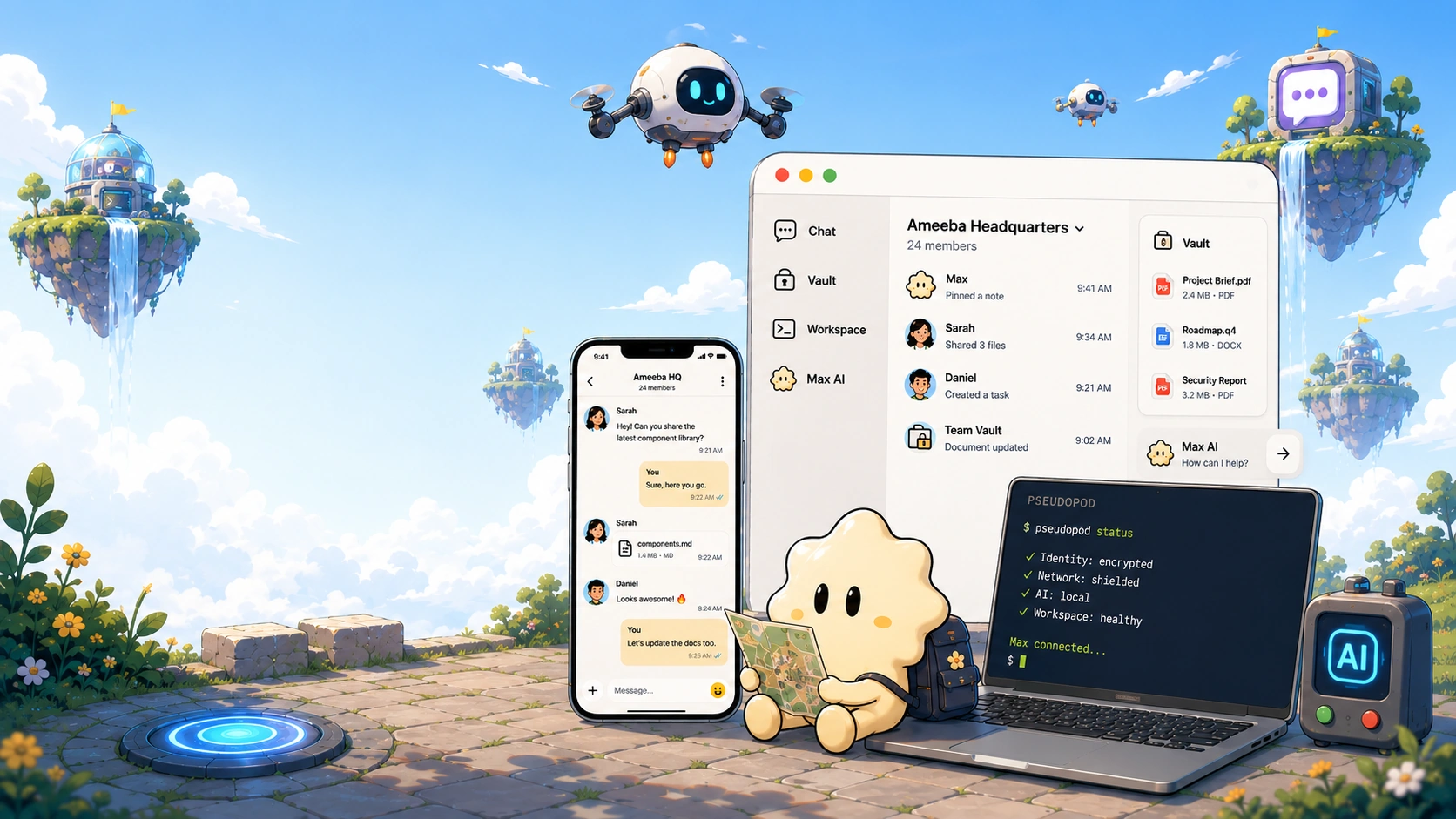
Everything your work needs. Connected.
Bring conversations, files, knowledge, AI, and compute into one place without losing the context between them.
Your workspace can share computing power.
Turn on Share Compute in a conversation and available Pseudopods can contribute to the work. Pool devices for more jobs at once. Cluster compatible machines for a larger AI workload.
Explore Ameeba ComputeProtect what you build.
Encrypted identity and protected collaboration are built into the workspace from the start.
Share without exposing ordinary identity.
Create an encrypted identity instead of using a phone number, email address, or public corporate profile.
Learn more 02End-to-End EncryptionKeep conversations private by design.
Messages, calls, and shared files are protected with end-to-end encryption, so only the people in the conversation can access them.
Learn more 03Encrypted workspaceKeep communication, files, and AI together.
Sensitive work stays inside one connected workspace instead of being scattered across exposed tools.
Learn moreAI that livesinside Ameeba.
Research, reason, create, and assist with the context already inside your workspace.
Explore MaxEnter The Severed World.
Meet Max beyond the workspace. Explore a world of finite compute, ancient mysteries, and the people fighting for its future.
Explore Ameeba Stories
The Severed World
A civilization is running out of the resource it needs to survive. Then people begin disappearing.
As Ameeba World runs out of Ameon, Max and his friends uncover an ancient trail through forgotten Gates and ruined worlds. At its end lies a Reserve that could save civilization, or place its future in the wrong hands.
Free to read. Download PDF or EPUB from the book page.